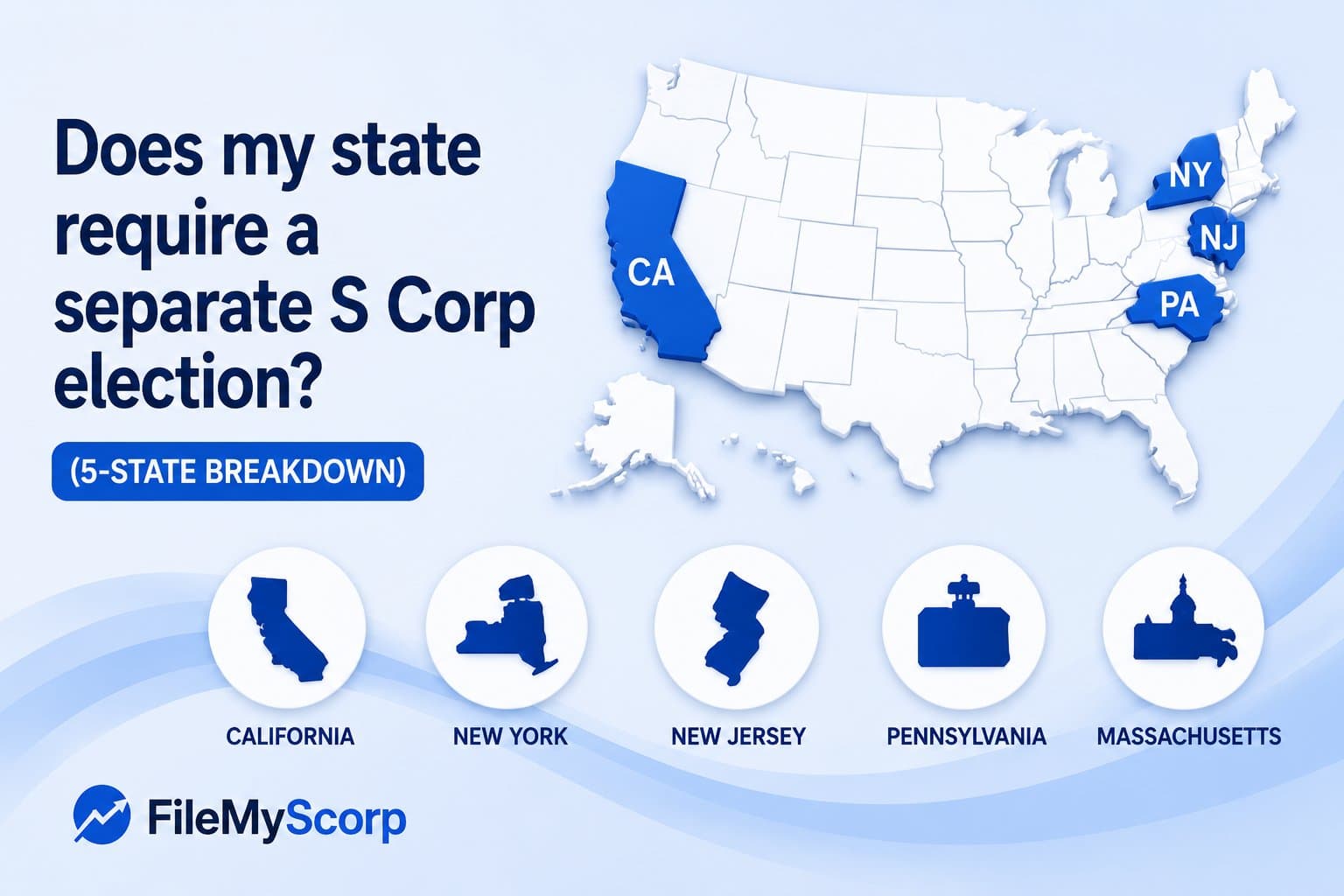
Does my state require a separate S Corp election? (2026 state-by-state guide)
A few states require a separate state-level S Corp election even after you file federal Form 2553 — and New Jersey famously stopped requiring one. Here's the current list, the forms, the deadlines, and the gotchas.
You filed federal Form 2553. The IRS sends you a CP261 letter. You think you're done. You're probably not.
Most states automatically honor your federal S Corp election — but a few states require a separate state filing, and a handful of others tax S Corps as ordinary corporations regardless of what the IRS says. Miss the state filing and you can end up paying federal-level S Corp savings while still owing state-level corporate tax. The math gets ugly fast.
2026 update: the list got shorter. New Jersey eliminated its separate S election — for tax years beginning on or after December 22, 2022, a valid federal S election automatically makes you a New Jersey S Corp (P.L. 2022, c. 133). Details in the NJ section below.
This is the field guide. We'll cover:
- The 4 states that still require a separate S election
- New Jersey's automatic-conformity rule (and the one case where you still file)
- The 6 jurisdictions that don't recognize federal elections at all
- The 39+ states (and DC, sort of) that automatically follow federal
TL;DR — the table
| Category | States | Action required |
|---|---|---|
| Auto-conforms to federal (most states) | 39 states | None — your CP261 is enough |
| Auto-conforms since Dec 22, 2022 | NJ | None going forward; retroactive filing only for pre-2023 tax years |
| Separate state election required | NY, AR, OH, WI | File state form within state-specific window |
| Doesn't recognize federal S election at all | LA, NH, TN, TX, DC, NYC | Pay state corporate tax regardless |
Find your state below. If you're in the auto-conforming bucket, this is a 30-second read. If you're in NY, AR, OH, or WI, keep going.
The 4 states that require a separate state filing
These states will treat your business as a regular corporation for state tax purposes unless you file a state-level S Corp election. Federal Form 2553 alone is not enough.
New York — Form CT-6
The form: Form CT-6 (Election by a Federal S Corporation to be Treated as a New York S Corporation), filed with the New York State Department of Taxation and Finance.
The deadline: Within 2 months and 15 days after the start of the tax year you want NY S Corp status to take effect. Same as federal.
The cost: $0 state filing fee. (You may need to pay franchise/MTA tax separately.)
The trap: New York City has its own corporate tax regime (the "General Corporation Tax" / GCT) and NYC does not recognize the federal S election for entity-level GCT purposes. NYC-based S Corps still pay GCT. The CT-6 only avoids state-level NY tax — it doesn't help with NYC.
Late filing: New York generally allows late CT-6 elections with a reasonable-cause statement, similar to Rev. Proc. 2013-30. File with the late narrative attached.
Form CT-6 instructions on tax.ny.gov
New Jersey — no longer on this list 🎉
New Jersey used to be the most notorious state on this page — Form CBT-2553, every shareholder's consent, and thousands of businesses accidentally taxed as NJ C Corps because nobody told them the state filing existed.
That's over. Under P.L. 2022, c. 133, for tax years beginning on or after December 22, 2022, New Jersey automatically treats a valid federal S corporation as a New Jersey S corporation. No CBT-2553, no separate state election — your accepted federal Form 2553 (the CP261 letter) covers New Jersey. You simply file your NJ return on Form CBT-100S like an S Corp.
Two leftover cases where paperwork still exists:
- Old tax years. If your federal S election predates the change and you never filed the NJ election for tax years beginning before December 22, 2022, those old years still need a retroactive NJ S corporation application through the Division of Taxation. This is cleanup-only — it doesn't affect current years.
- Opting out. A federal S Corp that wants to stay a C Corp for New Jersey purposes (a "hybrid") can do so with the consent of 100% of shareholders, documented by the 15th day of the 3rd month of the tax year. Rare, and you keep the records rather than filing a form with the state.
NJ Division of Taxation — S corporation procedural changes FAQ
Arkansas — Form AR1103
The form: Form AR1103 (Application for Subchapter S Status).
The deadline: Within 2 months and 15 days of the start of the tax year, plus a copy of your federal Form 2553 attached.
The cost: No filing fee.
The trap: Arkansas requires the original wet-ink signed AR1103 mailed to:
Arkansas Department of Finance and Administration, Corporation Income Tax, P.O. Box 919, Little Rock, AR 72203-0919
No fax option. Plan for postal transit time.
Form AR1103 on dfa.arkansas.gov
Ohio — automatic if federal election filed
The form: None specifically — Ohio S Corp status is automatic if the entity files a federal Form 2553 and provides a copy with its first Ohio return.
The deadline: With your first Ohio Form IT-1140 (S Corp pass-through return) of the year.
The cost: No separate filing fee.
The trap: Ohio's "Commercial Activity Tax" (CAT) applies to gross receipts over $150k regardless of S Corp status. Federal income tax savings don't help with CAT. If you have a high-revenue, low-margin business, run the numbers carefully.
Wisconsin — Form 5S election
The form: Wisconsin Department of Revenue Form 5S (Wisconsin Election by an S Corporation Not to be Taxed at the Entity Level), filed with the WI Department of Revenue.
The deadline: Within 3 months and 15 days of the start of the tax year. Late elections allowed with reasonable cause.
The cost: No fee.
The trap: Wisconsin instituted a 7.9% entity-level tax option for S Corps in 2018 (the "PTE election"). Your S Corp is now defaulted into entity-level tax unless you elect out via Form 5S. Counterintuitive, but it's how WI structures its S Corp regime. You generally want to elect out unless you specifically benefit from PTE treatment.
The 6 jurisdictions that don't recognize federal S election at all
These states/cities will tax your S Corp as a regular C Corp for state-level purposes regardless of your federal Form 2553.
Louisiana
Through 2025, Louisiana taxed S Corps under its Corporation Income Tax. As of January 1, 2026, this changed — Louisiana now accepts the federal S election and exempts S Corps from corporate income tax. (Franchise tax was repealed entirely in 2025.) You're now in the auto-conforming bucket — file federal only.
If you're filing for a tax year that began before January 1, 2026, the old rules still apply for that year.
New Hampshire
NH has no income tax on individuals, but it does have a "Business Profits Tax" (BPT, 7.5%) and a "Business Enterprise Tax" (BET) that apply to all entities including S Corps. Your federal pass-through treatment doesn't help. You will pay NH BPT/BET regardless.
Tennessee
TN repealed its individual income tax in 2021 (the "Hall tax"), but it retains a "Franchise and Excise Tax" that taxes S Corps at the entity level (6.5% excise on net earnings + a franchise tax). Federal S election doesn't override this.
Texas
TX has no individual income tax, but it has a "Franchise Tax" (a margin tax) that applies to S Corps with over $1.23M in revenue (the 2026 no-tax-due threshold). Federal S election doesn't waive it. Most small S Corps fall under the threshold and owe nothing — but the larger ones pay franchise tax regardless of S status.
District of Columbia
DC has its own "Unincorporated Business Franchise Tax" (UBT) and "Corporation Franchise Tax" that apply to S Corps. Federal pass-through doesn't help. You'll pay DC entity-level tax in addition to whatever your shareholders pay personally.
New York City (separate from NY State)
Even if you successfully file CT-6 to be a New York State S Corp, NYC's General Corporation Tax (GCT) still treats you as a C Corp for city-tax purposes. There's no NYC-level S election available. NYC S Corp owners pay both personal income tax on distributions and NYC GCT at the entity level — partial double tax.
What this means for your filing strategy
Three scenarios to plan for:
Scenario 1: You're in an auto-conforming state (most readers)
39 states automatically follow federal. File Form 2553, get your CP261 letter, you're done. State return is a pass-through 1120-S equivalent, no separate election needed.
States that auto-conform include: AL, AK, AZ, CA, CO, CT, DE, FL, GA, HI, ID, IL, IN, IA, KS, KY, ME, MD, MA, MI, MN, MS, MO, MT, NE, NV, NM, NC, ND, OK, OR, PA, RI, SC, SD, UT, VT, VA, WA, WV, WY.
Scenario 2: You're in NY, AR, or WI (3 of the 4 separate-filing states)
File federal Form 2553 first. Within 2–3 months, file your state form (CT-6 / AR1103 / Form 5S). Both elections need to be in place before the start of the tax year you want them effective.
New York filers: we file the CT-6 for you, free — check one box at intake and it rides alongside your federal 2553 (portal signing, fax to Albany, live status). AR1103 and Form 5S you'll handle separately or with a CPA.
Scenario 2½: You're in NJ
File federal Form 2553. That's it — since December 22, 2022, New Jersey follows your federal election automatically. (Only exception: retroactive cleanup for pre-2023 tax years.)
Scenario 3: You're in OH
File federal Form 2553. When you file your first Ohio return (Form IT-1140), include a copy of the federal form. No separate state form needed, but the federal copy must be attached.
Scenario 4: You're in LA (post-2026), NH, TN, TX, DC, or NYC
File federal Form 2553 for federal savings. Understand that you'll still owe state/city-level tax. Run the numbers — federal S election almost always still saves money, but the savings are smaller than in auto-conforming states.
A quick decision tree
Is your business in NY, AR, OH, or WI?
├── Yes → File federal 2553, then state form by state deadline
│         (NY: we file the CT-6 for you, free)
└── No
    │
    Is your business in LA (pre-2026), NH, TN, TX, DC, or NYC?
    ├── Yes → File federal 2553, owe state corporate tax anyway
    └── No → File federal 2553, you're done at the state level
              (yes, that includes New Jersey — automatic since Dec 2022)
What we file vs. what you file
FileMyScorp files: Federal Form 2553 — and for New York businesses, Form CT-6 too, free (check one box at intake; sign and track it from the same dashboard).
You (or your CPA) file: Any other state-level S election forms (AR1103, Form 5S) and ongoing state returns. We send a free state filing guide with every order to walk you through what your state requires.
File Your Federal S Corp Election With FileMyScorp
The federal piece — Form 2553 — is paper-only (no e-file, no IRS online portal), has to be faxed or mailed to the right service center, and a single missing signature voids the whole thing. FileMyScorp is the cheapest guided 2553 platform on the market, built for owners who want to file it themselves without becoming IRS-routing experts.
- The cheapest pricing in the market. $49 fax · $50 certified mail · $99 for both (same-day). Flat one-time fee, no subscription, no upsells.
- Fax AND certified mail in one place. Most filers do one or the other. We dispatch both same-day, auto-route to the correct IRS service center for your state (Kansas City vs. Ogden), and track delivery on your dashboard.
- DIY-first, no consultation upsell. Owner does the ~10-minute intake. Shareholders e-sign on their phones. We prepare, sign, send.
- Late elections free. Rev. Proc. 2013-30 narrative auto-assembled from a 4-question form — no extra tier, no surcharge.
- Free state filing guide included. Mailed with every order, walks you through what your state requires.
Start your filing → — most filings go from intake to fax confirmation in under an hour.
State tax laws change frequently. The summaries above reflect 2026 rules but always check your state Department of Revenue for current forms and deadlines. This is not legal or tax advice — consult your CPA for situation-specific questions.
Related articles
- September 9, 2026 · 8 minThe Form 2553 Deadline for 2026 (and What to Do Now)The Form 2553 deadline for 2026 was March 16. Here's what still works in September: the 2-month-15-day rule for new entities, late relief, and electing for 2027.
- August 26, 2026 · 9 minWhy S Corp elections eat your billable hours (and what tax pros can actually control)A successful fax confirmation is not proof your S election was processed. What practitioners are actually seeing with Form 2553 — vanished elections, entity-mismatch rejections, and the workarounds that get returns filed.
- August 5, 2026 · 4 minNew Jersey S Corp Election: Why You (Probably) Don't Need to File AnythingSince December 22, 2022, New Jersey automatically honors your federal S Corp election — no Form CBT-2553, no separate state filing. Here's how the rule works, the two exceptions, and how NJ compares to New York.