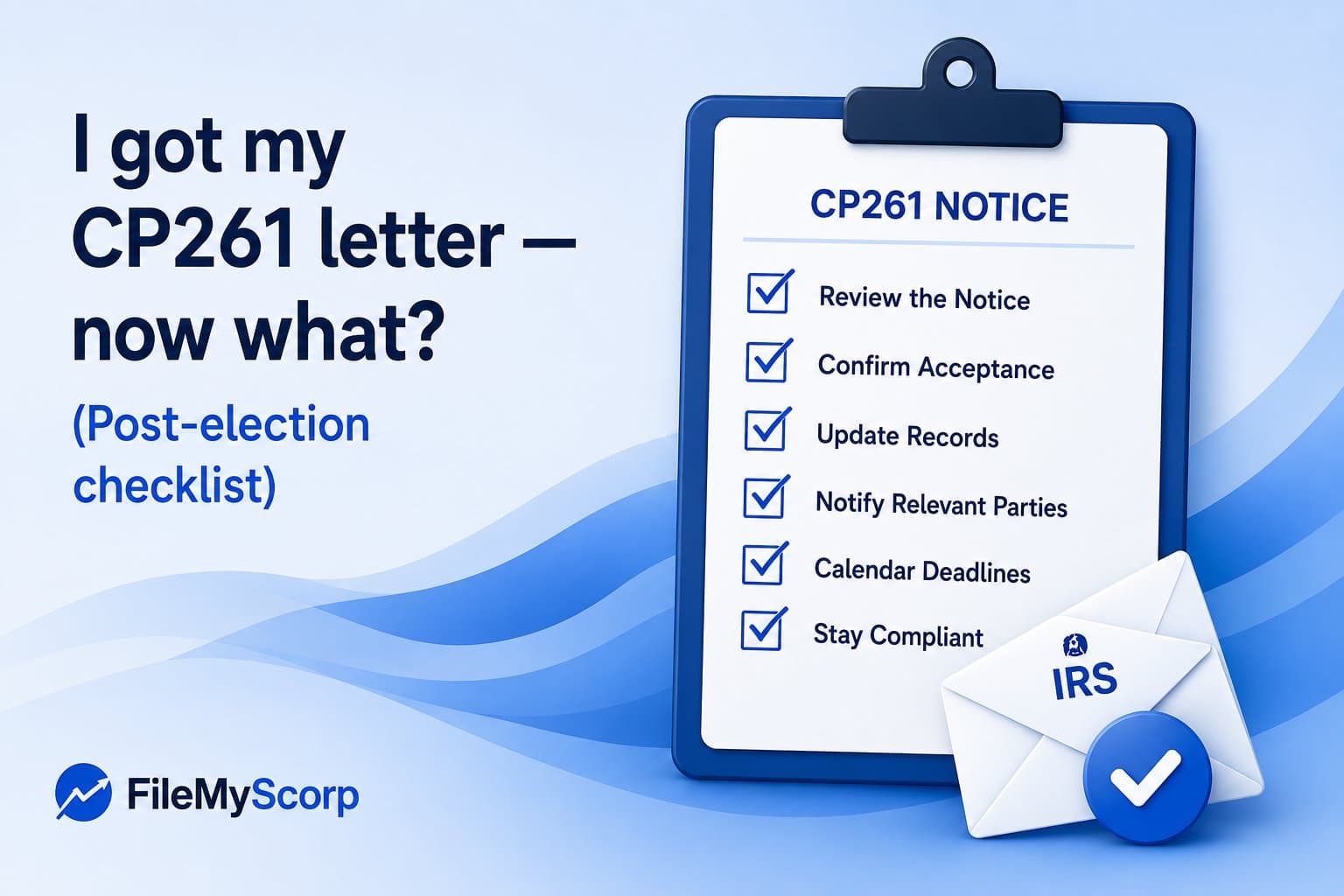
I got my CP261 letter — now what? (post-election checklist)
Got your CP261 acceptance letter? Here's exactly what to do next — payroll setup, tax form changes, deadlines you'll start hitting, and what to put in your records.
The CP261 letter arrives, you read "We have approved your election to be an S Corporation," and you think you're done. You're maybe 30% done.
The election by itself doesn't save you anything. The savings come from how you operate after the effective date — the payroll, the bookkeeping, the new tax forms, the W-2 you issue yourself. Skip the operational shift and you'll still owe self-employment tax on everything because the IRS will see no W-2 wages and reclassify all distributions.
Here's the field-tested checklist for what to do in the first 90 days after CP261.
First: store the CP261 letter where you can find it
The IRS does not re-issue CP261 letters. If you lose it, you have to call the IRS Business & Specialty Tax Line (800-829-4933) and beg for a replacement, which takes weeks.
Do this today:
- Scan the letter to PDF and save it in your business records folder
- Email a copy to yourself with subject line
[Permanent record] CP261 — [business name] - Original goes in your corporate records binder with your Articles of Organization, EIN letter, and Form 2553 copy
If you used FileMyScorp, your dashboard already has the CP261 stored against your filing — but keep your own copy too.
Within 7 days: tell your CPA / accountant
The single biggest mistake we see is owners who file Form 2553 themselves and then bring it up at their next quarterly check-in three months later. By then they've missed the payroll setup window and the IRS estimated tax dates.
Email your CPA: subject "S Corp election effective [date]." Include:
- Effective date of the election
- Copy of the CP261 letter
- Your federal Form 2553 PDF
- A brief note on what salary you're planning to take
They'll come back with a payroll start date and a quarterly tax plan.
If you don't have a CPA, this is the moment to get one. S Corps are not the place to DIY tax prep — Form 1120-S is materially more complex than Schedule C, and reasonable-comp documentation matters.
Within 14 days: set up payroll
This is non-negotiable. The whole point of the S Corp election is paying yourself a W-2 salary instead of taking everything as draw. No payroll = no W-2 = no defensible reasonable comp = audit risk.
Three reasonable options:
| Provider | Monthly cost | Best for |
|---|---|---|
| Gusto | $40 base + $6/employee | Most owners — clean UI, integrates with QuickBooks/Xero, free payroll tax filings |
| OnPay | $40 base + $6/employee | Slightly cheaper than Gusto with similar features |
| QuickBooks Payroll | $50–$85/mo | If you already use QuickBooks Online and want one login |
Pick one, sign up, run your first payroll within two weeks. If your election was effective months ago and you haven't run any payroll yet, your provider can do "make-up" payroll runs to backfill — or you can do a single year-end bonus that brings annual W-2 wages up to your defensible salary level.
A common trap: setting up payroll but never actually running it because cash flow is tight. Bad idea. Even one payroll run per quarter is better than none — it establishes the W-2 record. Quarterly, monthly, or twice-monthly all work; pick a cadence and stick to it.
Within 30 days: open a separate business bank account (if you haven't)
If you've been mixing personal and business funds, stop. S Corps need clean books for the 1120-S, and commingled accounts make audit defense miserable.
What you need:
- A dedicated business checking account
- A dedicated business credit card (for expense tracking)
- All client revenue deposited into the business account
- All business expenses paid from the business account
- Owner pay flows business → personal via payroll (W-2 wages) and quarterly distributions
Mercury, Bluevine, Relay, Chase, BofA — pick one, open it. Most online business banks open in 5–10 minutes if you have your EIN letter handy.
Within 30 days: book Form 1120-S deadline in your calendar
This is the one most new S Corp owners miss in year one and get hit with a $220-per-shareholder-per-month penalty.
Form 1120-S is due March 15 (calendar-year S Corps). You can extend to September 15 with Form 7004, but it has to be filed by March 15 itself.
Your first 1120-S covers the period from your effective date through December 31. If your election was effective March 1, 2026, your first 1120-S covers March 1–December 31, 2026 and is due March 15, 2027.
Set the calendar reminder now. A January 1 reminder titled "Form 1120-S due in 75 days — start with CPA" is your future self's best friend.
Within 60 days: change how you book transactions
Some categories that didn't matter as a sole prop now matter a lot:
- Owner draws → Owner distributions, recorded against equity not expense
- Health insurance premiums for >2% shareholders — must be added to your W-2 as taxable wages (line 14, code DD), recoverable as a deduction on personal return
- Business expenses paid personally — owner reimbursement (accountable plan recommended), not "owner contribution"
- Vehicle/home office — switch from sole-prop deduction to accountable-plan reimbursement to avoid losing 2% itemized-deduction floor
Your CPA can set up an accountable plan template in 30 minutes. Worth doing.
Around month 3: review your reasonable salary against actual hours
The reasonable comp number you picked when you elected was a forecast. After 90 days you have data — actual hours worked, revenue trend, market rate movement. Sit with your CPA and adjust if needed.
A common pattern:
- Q1 forecast salary: $60,000/year ($5k/month)
- Actual: owner working 50 hrs/week, business growing 30% YoY
- Adjusted: $80,000/year — bump payroll, document the basis
The IRS doesn't expect you to nail compensation perfectly on day 1. They expect you to act in good faith and adjust based on data. Annual reviews documented in a memo are how you defend a salary that grew over time.
Things to expect in year one
A few things will happen that didn't happen as a sole prop:
- Quarterly Form 941 payroll tax filings (your payroll provider does this for you, but you'll see them in the system)
- Form 940 annual federal unemployment (also payroll provider)
- State unemployment quarterly filings (also payroll)
- A W-2 issued to yourself in January
- Form 1120-S in March, then a K-1 to yourself
- K-1 income flows onto your personal 1040 Schedule E (not Schedule C anymore)
The first year there's a learning curve. Year two it's autopilot.
What about state-level tax obligations?
If you're in NY, NJ, AR, OH, or WI you needed a separate state-level S election (see our state guide). If you didn't file the state form, your state still treats you as a regular corporation and you'll owe corporate-level state tax until you fix it.
If you're in LA (pre-2026), NH, TN, TX, DC, or NYC, you'll owe state/local entity-level tax even with the federal election in place. Your CPA needs to factor this into estimated payments.
A 90-day calendar in plain English
| Day | What to do |
|---|---|
| 1 | Store CP261 in 3 places (cloud, email, paper) |
| 1–7 | Email CPA with election details |
| 7–14 | Sign up for payroll service (Gusto / OnPay / QB) |
| 14–21 | Run first payroll, even if small |
| 14–30 | Open business bank if you haven't |
| 30 | Calendar reminder for next year's Form 1120-S deadline |
| 30–60 | Update bookkeeping categories with CPA |
| 60–90 | Set up accountable plan for reimbursements |
| 90 | Reasonable-comp review with CPA |
What we don't help with after CP261
We're a Form 2553 filing service. After your CP261 lands, our work is done — the rest (payroll, 1120-S, bookkeeping, state filings) is on you and your CPA. We mention this so there's no confusion: a $49 election filing doesn't include ongoing tax compliance. The election is the event; everything in this article is the operation.
Don't have your CP261 yet?
If you're still waiting on the IRS letter (which can take 30–60 days, sometimes longer during peak tax season), bookmark this article. You'll need it the day the letter arrives.
If you haven't filed Form 2553 yet, that's the place to start.
File Your S Corp Election With FileMyScorp
FileMyScorp is the cheapest guided 2553 platform on the market — built for owners who want to file it themselves without becoming IRS-routing experts.
- The cheapest pricing in the market. $49 fax · $50 certified mail · $99 for both (same-day). Flat one-time fee, no subscription, no upsells.
- Fax AND certified mail in one place. Most filers do one or the other. We dispatch both same-day, auto-route to the correct IRS service center for your state (Kansas City vs. Ogden), and track delivery on your dashboard.
- DIY-first, no consultation upsell. Owner does the ~10-minute intake. Shareholders e-sign on their phones. We prepare, sign, send.
- Late elections free. Rev. Proc. 2013-30 narrative auto-assembled from a 4-question form — no extra tier, no surcharge. (Up to 3 years 75 days back.)
- Live status from intake → CP261. Every milestone (signed, faxed, delivered, certified-mail tracking, IRS acceptance letter received) hits your inbox and your dashboard.
Start your filing → — most filings go from intake to fax confirmation in under an hour.
Related articles
- September 9, 2026 · 8 minThe Form 2553 Deadline for 2026 (and What to Do Now)The Form 2553 deadline for 2026 was March 16. Here's what still works in September: the 2-month-15-day rule for new entities, late relief, and electing for 2027.
- August 26, 2026 · 9 minWhy S Corp elections eat your billable hours (and what tax pros can actually control)A successful fax confirmation is not proof your S election was processed. What practitioners are actually seeing with Form 2553 — vanished elections, entity-mismatch rejections, and the workarounds that get returns filed.
- August 5, 2026 · 4 minNew Jersey S Corp Election: Why You (Probably) Don't Need to File AnythingSince December 22, 2022, New Jersey automatically honors your federal S Corp election — no Form CBT-2553, no separate state filing. Here's how the rule works, the two exceptions, and how NJ compares to New York.