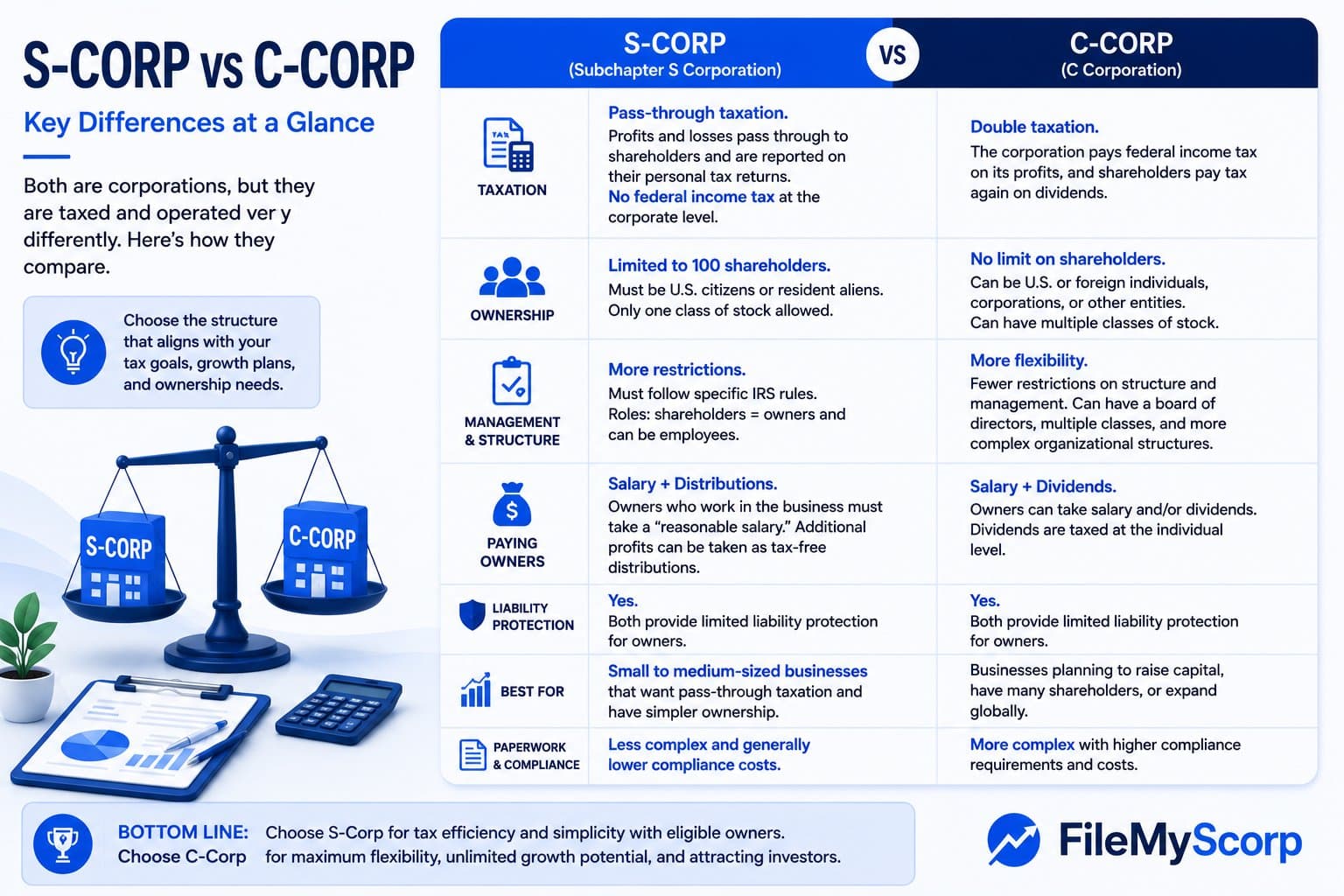
S Corp vs C Corp in 2026: The $35,000 Question Most Small Business Owners Get Wrong
S Corp vs C Corp explained for solo owners and small businesses. Real $200k example, when each one wins, the QSBS exit math, and the gotchas your CPA might not mention.
If you're searching "S Corp vs C Corp," there's a 90% chance you've already watched a YouTube video where a guy in a suit with a green-screen of stock charts behind him says the magic words: "the rich don't pay taxes."
Cool. Helpful. Now you have to actually pick one.
Here's the part those videos skip: for most small business owners earning between $60,000 and $500,000, the difference between an S Corp and a C Corp election can be over $35,000 a year. Not in the future. This year.
This is the no-hype, plain-English breakdown we wish someone had given us before we picked.
TL;DR (because you're busy running a business)
- S Corp = profits pass through to your personal tax return. Taxed once. Saves you self-employment tax. Best for most small business owners under ~$500k in profit.
- C Corp = the company pays its own 21% tax. Then YOU pay tax again when you take money out. Taxed twice. Best for VC-backed startups and anyone planning a $10M+ exit.
- The default for most readers of this post is S Corp. If you're a freelancer, consultant, contractor, e-commerce owner, real estate operator, or service business owner, keep reading.
- C Corp makes sense in exactly three scenarios. We'll cover them.
What Actually Happens (in plain English)
A C Corp is a separate "person" to the IRS
When your C Corp earns $200,000, here's what happens:
- The corporation pays 21% federal corporate income tax on the $200,000. That's $42,000 gone.
- You're left with $158,000 inside the company.
- Want to put that money in your pocket? You pay yourself a dividend.
- Now you pay tax on the dividend at 0%, 15%, or 20% federal (plus a possible 3.8% net investment income tax). For most owners, that's another 15–23.8%.
- By the time the money hits your checking account, you've paid a combined effective rate of 36–40%.
This is what "double taxation" means. The IRS taxed the same dollar twice — once at the corporate level, once when it crossed over to you.
An S Corp is a "tax election," not a different company
Here's what nobody on YouTube explains clearly: an S Corp is not an entity. It's a tax election.
You form an LLC (or a corporation). Then you file IRS Form 2553 to elect S Corp tax treatment. Your business is still legally an LLC. The IRS just agrees to tax you under different rules.
Under those rules:
- The business pays zero federal income tax.
- All profit "passes through" to your personal Form 1040.
- You pay tax once, at your individual rate (10–37%).
- You may qualify for the 20% Qualified Business Income (QBI) deduction under Section 199A — which is now permanent thanks to the One Big Beautiful Bill Act signed in July 2025.
- You also save on self-employment tax (15.3% on Social Security + Medicare) on the portion you take as distributions vs. salary.
For most small business owners, this is dramatically cheaper.
The $200,000 Example (Real Numbers)
Let's run the same business under both structures. Single owner, $200,000 in net profit, no other income.
As a C Corp:
| Item | Amount |
|---|---|
| Net profit | $200,000 |
| Federal corporate tax (21%) | -$42,000 |
| After-tax profit available for dividend | $158,000 |
| Dividend tax to you (15% qualified rate) | -$23,700 |
| Cash in your pocket | $134,300 |
As an S Corp:
| Item | Amount |
|---|---|
| Net profit | $200,000 |
| Reasonable salary you pay yourself | $80,000 |
| Distribution (the rest) | $120,000 |
| Self-employment tax (only on $80k salary) | -$12,240 |
| Federal income tax (after 20% QBI deduction) | ~$28,000 |
| Cash in your pocket | ~$159,760 |
Difference: about $25,000 in your pocket. And that's a conservative example. With state taxes layered in (especially in California, New York, or New Jersey), the gap regularly exceeds $35,000.
This is the "rich people trick" the YouTube influencers are talking about. It's not a trick. It's just picking the right tax election.
When the C Corp Actually Wins
We're not going to pretend C Corps are never the right answer. They are — in three specific situations:
1. You're raising venture capital
VCs almost always require C Corp structure. They want preferred stock. They want multiple classes of shares. They want to be able to invest through their fund (which can't own S Corp stock — S Corps cap shareholders at 100 and can't have entity owners). If you're going to raise institutional money, you'll be a Delaware C Corp. Period.
2. You're planning a $10M+ exit (QSBS)
Qualified Small Business Stock (QSBS) under Section 1202 is the single biggest reason successful founders pick C Corp. After OBBBA in 2025, the rules got even more generous:
- Hold C Corp stock for 5+ years → 100% capital gains exclusion on the first $15M of gain (up from $10M).
- 3 years → 50% exclusion. 4 years → 75% exclusion. (New tiered structure post-OBBBA.)
If you sell your company for $15M, that's potentially zero federal tax on the entire gain. Translation: a successful exit can be worth millions more under C Corp structure.
But — and this is critical — this only matters if you actually expect to sell. If you're running a service business, freelance practice, or anything you plan to operate for the long term, QSBS is irrelevant.
3. You want to reinvest everything back into the business
If you genuinely don't plan to take money out for a long time — you're plowing every dollar back into growth — C Corp's 21% flat rate can be cheaper than passing income through to your personal return at 32–37%. The "double" in "double taxation" only triggers when you distribute. Retain the cash, defer the second tax.
This works for some growing companies. It does NOT work for solo operators who need to pay rent.
When the S Corp Wins (i.e., for most people reading this)
You should almost certainly elect S Corp if:
- You're a single owner or a small group of US-based co-founders
- Your net profit is between roughly $40k and $500k
- You take money out of the business to live on
- You're not planning a venture exit
- You want to save 7–15% on self-employment tax
- You want the 20% QBI deduction
That's most freelancers, consultants, agency owners, contractors, real estate investors, e-commerce sellers, coaches, and small service businesses.
The Gotchas Nobody Mentions
Gotcha #1: "Reasonable salary" isn't optional
If you're an S Corp owner who works in the business, the IRS requires you to pay yourself a reasonable salary before taking distributions. You can't pay yourself $0 salary and take $200k as distributions to dodge payroll tax. The IRS audits this. They'll reclassify distributions as wages and hit you with back-payroll tax + penalties.
Rule of thumb: salary should reflect what you'd pay someone else to do your job. We have a full guide on reasonable comp with industry benchmarks and worked examples.
Gotcha #2: S Corps can hurt your Social Security check
This is the one your CPA might not bring up. By taking less salary (and more distributions), you pay less into Social Security. Decades from now, that means a smaller monthly Social Security check in retirement.
A typical owner who saves $7,500/year on FICA might give up $10,000–$16,000/year in Social Security benefits 30 years later. For most people the math still favors S Corp — but it's not free money. Know the trade-off.
Gotcha #3: S Corps have ownership restrictions
S Corps cap out at 100 shareholders, all of whom must be US individuals or qualifying trusts. No foreign owners. No corporate owners. No more than one class of stock. If you want to bring on an investor abroad, sell stock to a holding company, or issue preferred shares — you'll have to convert to C Corp.
Gotcha #4: There's a deadline
If you formed your LLC this year and want S Corp treatment for this tax year, you must file Form 2553 within 2 months and 15 days of formation (or by March 15 for an existing entity). Miss it and you wait until next year — or file a late election under Rev. Proc. 2013-30 with a reasonable cause statement (which the IRS sometimes grants).
This is exactly why people procrastinate, miss the window, and overpay self-employment tax for an extra year.
Side-by-Side Comparison (Fast Reference)
| Feature | S Corp | C Corp |
|---|---|---|
| Federal tax rate | Pass-through (10–37% personal) | 21% flat corporate |
| Double taxation? | No | Yes, on dividends |
| QBI 20% deduction? | Yes (now permanent) | No |
| Self-employment tax savings? | Yes, on distributions | N/A |
| Shareholder limit | 100 | Unlimited |
| Foreign owners allowed? | No | Yes |
| Multiple stock classes? | No | Yes |
| Best for VCs? | No | Yes |
| Best for $10M+ exit (QSBS)? | No | Yes |
| Best for solo owners under $500k? | Yes | Rarely |
How to Actually Make the Election
If you've decided S Corp is right for you, here's the actual process:
- Form an LLC (if you don't already have one). Most states. Most online filing services.
- Get an EIN from the IRS. Free. Takes 10 minutes.
- File Form 2553 with the IRS to elect S Corp tax treatment. This is the form everyone's afraid of. It's two pages — read our step-by-step Form 2553 guide for the section-by-section walkthrough.
- Set up payroll so you can pay yourself a reasonable salary.
- File Form 1120-S every year going forward (your S Corp tax return).
Steps 1, 2, and 3 are the tricky part. Step 3 — Form 2553 — is the single most-bungled form in small business tax. Filed late? Election denied. Filled out wrong? Election denied. Wrong year selected? Election denied.
The Bottom Line
If you remember nothing else from this post:
- S Corp if you're a small business owner taking money out to live on. Save thousands per year.
- C Corp if you're raising VC, planning a big exit, or genuinely reinvesting everything for years.
- The "rich don't pay taxes" YouTube videos are technically right, but they're selling you a $1,500 strategy session for a problem solved by a $200 form.
The hardest part isn't picking. It's actually filing the form on time, correctly, with the right tax year box checked.
File Your S Corp Election With FileMyScorp
Once you've decided the S Corp is right for your numbers, the actual filing is just one form — IRS Form 2553 — but it's paper-only (no e-file, no IRS online portal), it has to be faxed or mailed to the right service center, and a single missing signature voids the whole thing. Most options are either a CPA charging $300–$800 to handle it, or a blank PDF and a "good luck." FileMyScorp sits in between: the cheapest guided 2553 platform on the market, built for owners who want to file it themselves without becoming IRS-routing experts.
- The cheapest pricing in the market. $49 fax · $50 certified mail · $99 for both (same-day). Flat one-time fee, no subscription, no upsells.
- Fax AND certified mail in one place. Most filers do one or the other. We dispatch both same-day, auto-route to the correct IRS service center for your state (Kansas City vs. Ogden), and track delivery on your dashboard.
- DIY-first, no consultation upsell. Owner does the ~10-minute intake. Shareholders e-sign on their phones. We prepare, sign, send.
- Late elections free. Rev. Proc. 2013-30 narrative auto-assembled from a 4-question form — no extra tier, no surcharge.
- Live status from intake → CP261. Every milestone (signed, faxed, delivered, certified-mail tracking, IRS acceptance letter received) hits your inbox and your dashboard.
Start your filing → — most filings go from intake to fax confirmation in under an hour.
This article is for educational purposes only and is not tax advice. Every business situation is different. If you have unusual income, multiple owners, foreign considerations, or you're planning a sale, talk to a tax professional before electing.
Sources
- S-Corp vs C-Corp Taxes: Which Saves More? (2026) — SDO CPA
- S Corp vs C Corp vs LLC vs Partnership in 2026 — KDA Inc.
- S Corp vs C Corp: Key Differences and Benefits — Wolters Kluwer
- 2026 Federal Corporate Tax Rates and Minimum Tax Rules — VisaVerge
- QBI Deduction 2026: Section 199A Guide — SDO CPA
- One Big Beautiful Bill Act: QBI Deduction (Section 199A) — Foster Garvey
- C-Corp Double Taxation Explained — SDO CPA
- C-Corporation Tax Guide: Rates, QSBS, Double Taxation — SDO CPA
- Qualified Business Income Deduction — IRS
Related articles
- September 9, 2026 · 8 minThe Form 2553 Deadline for 2026 (and What to Do Now)The Form 2553 deadline for 2026 was March 16. Here's what still works in September: the 2-month-15-day rule for new entities, late relief, and electing for 2027.
- August 26, 2026 · 9 minWhy S Corp elections eat your billable hours (and what tax pros can actually control)A successful fax confirmation is not proof your S election was processed. What practitioners are actually seeing with Form 2553 — vanished elections, entity-mismatch rejections, and the workarounds that get returns filed.
- August 5, 2026 · 4 minNew Jersey S Corp Election: Why You (Probably) Don't Need to File AnythingSince December 22, 2022, New Jersey automatically honors your federal S Corp election — no Form CBT-2553, no separate state filing. Here's how the rule works, the two exceptions, and how NJ compares to New York.