What Does It Really Cost to Maintain an S Corp? (2026 Annual Cost Breakdown)
The honest cost of running an S Corp in 2026. Payroll, bookkeeping, 1120-S tax prep, state franchise fees, registered agent, and the hidden costs nobody talks about. Plus break-even math.
Every blog post about S Corps starts with the savings. Almost none of them talk about the costs honestly. So let's flip the script.
If you're considering an S Corp election, or you've already filed Form 2553 and are about to start running one, you need to know what the ongoing costs actually look like — not the marketing-friendly version, but the realistic full-year-of-operating-an-S-Corp version. The savings are real (we've written about them at length), but they only matter relative to the costs you'll incur to keep the structure compliant.
This guide walks through every line item that shows up in a typical S Corp's annual maintenance budget — payroll, bookkeeping, tax prep, state fees, registered agent, reasonable comp studies, and the hidden costs nobody talks about until they've already paid them. We pulled this together from what the most-watched S Corp YouTube channels and CPA blogs report, what we see day-to-day with real S Corps, and what shows up in the actual quotes from payroll providers and tax preparers in 2026.
By the end, you'll have a realistic number for what running your S Corp will cost — and a clean break-even framework for whether the savings outweigh those costs.
The Quick Answer
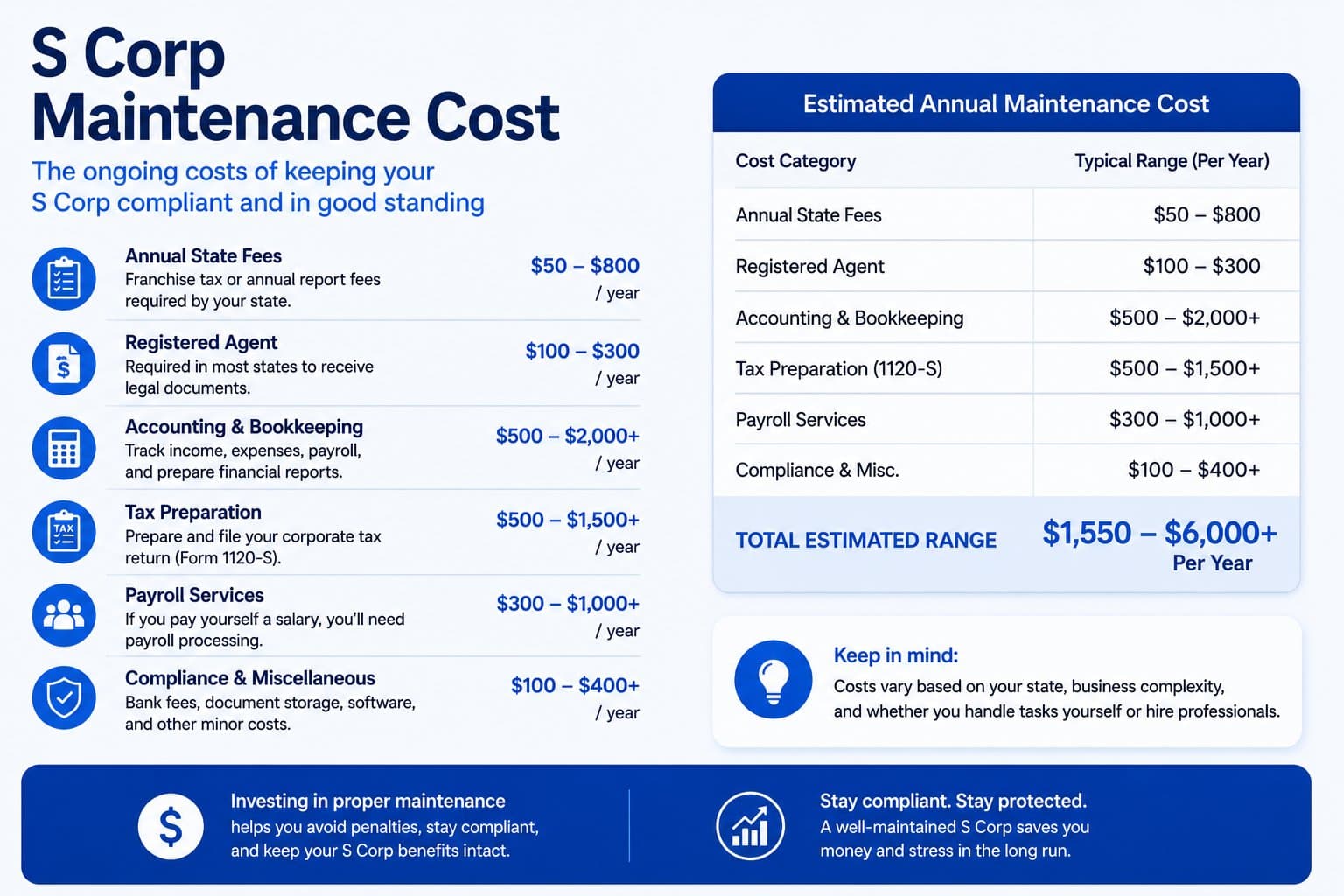
For a typical owner-operator S Corp in 2026, expect to spend somewhere between $2,500 and $7,500 per year on ongoing maintenance, with the average landing around $3,500–$5,000. Smaller, simpler businesses (single owner, single state, basic books) live at the low end. Larger or more complex businesses (multi-state, employees, higher revenue, complex deductions) live at the high end.
Here's the breakdown, with realistic 2026 ranges for each line item:
| Cost item | Typical annual range |
|---|---|
| Payroll service (1 employee/owner) | $400–$1,200 |
| Bookkeeping (DIY to outsourced) | $0–$4,800 |
| S Corp tax return (Form 1120-S) prep | $1,000–$3,500 |
| Personal Form 1040 (with K-1) prep | $300–$800 |
| State annual report / franchise fee | $25–$800+ (state-dependent) |
| Registered agent | $100–$300 |
| Reasonable comp study | $0–$500 (every 2–3 years) |
| Accounting software (QuickBooks/Xero) | $360–$960 |
| Workers' comp / disability insurance | $200–$1,000+ (state-dependent) |
| Total realistic range | $2,500–$7,500/year |
Now let's go line by line.
Cost #1: Payroll Service ($400–$1,200/year)
This is the cost most people forget when they're doing back-of-the-envelope S Corp math.
The IRS requires S Corp shareholder-employees who provide significant services to be paid through W-2 payroll. That means setting up a payroll system that:
- Calculates federal income tax withholding, Social Security, and Medicare each pay cycle.
- Files quarterly federal payroll tax returns (Form 941).
- Files an annual federal unemployment tax return (Form 940).
- Issues W-2 and W-3 forms at year-end.
- Files state-equivalent returns and pays state withholding and unemployment.
You can technically do this yourself with the IRS forms and a spreadsheet, but virtually no one should. The cost of getting it wrong (penalties for missed deposits, late filings, miscalculated taxes) is far higher than the cost of using a real payroll service.
Realistic 2026 pricing for the major small-business payroll services:
- Gusto Simple: $40/month + $6/employee. So for a single owner, ~$552/year.
- OnPay: $40/month + $6/employee. ~$552/year for single owner.
- SurePayroll Self-Service: $19.99/month + $4/employee. ~$288/year.
- SurePayroll Full-Service: $25.99/month + $5/employee. ~$372/year.
- Square Payroll: $35/month + $6/employee. ~$492/year.
- QuickBooks Payroll Core: $50/month + $6/employee. ~$672/year.
- ADP Run / Paychex Flex: Higher and more variable; typically $80–$150/month for similar service. $960–$1,800/year.
For a one-person S Corp, expect to spend roughly $400–$700/year on payroll. For an S Corp with a few employees in addition to the owner, you'll be in the $700–$1,500/year range.
Tip: When you're shopping payroll providers, the difference is less about the monthly price and more about whether the provider handles all the federal AND state filings for you. A "self-service" plan that leaves state filings to you isn't a good deal at any price.
Cost #2: Bookkeeping ($0–$4,800/year)
Bookkeeping is the cost item with the widest range, because it depends entirely on whether you do it yourself or pay someone.
DIY bookkeeping in QuickBooks or Xero, if you have decent tools and you're disciplined, costs essentially $0 in cash terms — but a meaningful amount of your time (typically 5–15 hours/month for a small S Corp). For owners with simple businesses, this is workable.
Outsourced bookkeeping runs a wide range:
- Lower end ($150–$300/month): Basic monthly reconciliation, categorization, and reporting from a virtual bookkeeper. Good fit for small S Corps with low transaction volume.
- Mid ($300–$600/month): More comprehensive — monthly reconciliation, AP/AR tracking, basic financial statements, monthly review calls. Common for S Corps doing $200K–$1M in revenue.
- Higher end ($600–$1,500+/month): Full-service bookkeeping including AP, AR, expense management, payroll integration, monthly reports, possibly fractional CFO services. Suited for larger or more complex S Corps.
For a typical owner-operator S Corp doing under $500K in revenue and paying for outsourced bookkeeping, plan on $3,000–$4,800/year. For a DIY owner who uses QuickBooks Online competently, the cost is just the software (covered separately below).
A surprising number of S Corp owners go DIY in year one to save money and end up regretting it by year three when they realize their books are too messy for their CPA to work with cleanly. If your time costs more than $40/hour and you don't enjoy bookkeeping, paying someone is almost always the right move.
Cost #3: S Corp Tax Return Preparation — Form 1120-S ($1,000–$3,500/year)
The 1120-S is the federal informational return your S Corp has to file each year, plus state equivalents and K-1s for each shareholder. CPA pricing varies widely:
- Basic 1120-S, single owner, single state, clean books: $1,000–$1,500 from a smaller firm or independent CPA.
- Mid-complexity 1120-S, owner plus a few employees, single state, multiple deduction categories: $1,500–$2,500.
- Complex 1120-S — multiple states, depreciation schedules, multiple owners with K-1s, fixed asset tracking, retirement plan reporting: $2,500–$5,000+.
This is one cost where the cheapest option is usually not the smartest. A $1,000 prep that misses a deduction or gets your reasonable comp wrong can cost you thousands in extra tax or audit exposure. Most S Corp owners are well-served by paying a CPA who specializes in small business and S Corps rather than trying to find the cheapest option.
Two pricing tips:
- Many CPAs bundle 1120-S prep with bookkeeping, payroll oversight, and reasonable comp studies into a flat monthly fee ($300–$800/month). This often works out better than paying à la carte.
- Always ask whether 1120-S prep includes K-1s for each shareholder, multi-state filings (if applicable), and a tax planning conversation. Some firms charge for these separately.
Cost #4: Personal Tax Return (Form 1040) Prep ($300–$800/year)
Once your S Corp issues you a K-1, your personal Form 1040 becomes a bit more complicated than a simple W-2-only return. Most CPAs charge:
- Basic 1040 with K-1: $300–$500.
- More complex 1040 with K-1, itemized deductions, multiple income sources: $500–$1,000.
If you're already paying a CPA for your 1120-S, they often discount your personal return when bundled. Expect $300–$600 for a typical S Corp owner's personal return.
Cost #5: State Annual Report and Franchise Fees ($25–$800+/year)
Almost every state requires LLCs and corporations to file a yearly (or biennial) annual report, often with a small fee. Some states also tack on franchise taxes or other entity-level fees. Highlights:
- Wyoming: $60/year annual report. No state income tax. No franchise tax.
- Delaware: $300/year franchise tax for LLCs. Higher for corporations depending on shares.
- Florida: $138.75/year annual report.
- Texas: No annual report fee for LLCs, but the Texas Margin Tax may apply (though most small businesses fall under the no-tax-due threshold).
- California: $800/year minimum LLC tax PLUS the 1.5% S Corp franchise tax (minimum $800). So a CA S Corp pays at least $1,600/year just in state-level fees, regardless of profit.
- Illinois: $75 annual report + the Personal Property Replacement Tax (1.5% of net income for S Corps).
- New York: $9/year for LLCs (state) plus separate publication requirements that can be expensive in some counties; varies for corps.
For most states, plan on $50–$300/year for annual report and basic franchise fees. California is the obvious outlier where you should plan for $1,600+ just on state-level fees.
Cost #6: Registered Agent Service ($100–$300/year)
Every state requires your business entity to maintain a registered agent — a person or company with a physical address in the state who can receive legal documents on the business's behalf. You can be your own registered agent if you have a physical address in the state and don't mind being publicly listed. Most owners use a service for privacy and reliability reasons.
Common registered agent service pricing:
- Northwest Registered Agent: $125/year.
- ZenBusiness: $199/year (sometimes free for the first year with formation packages).
- LegalZoom: $249–$299/year.
- State-specific niche providers: $50–$150/year.
For a single-state S Corp, expect $100–$200/year. If you operate in multiple states (and need to register as a foreign entity in each), multiply by the number of states.
Cost #7: Reasonable Compensation Study ($0–$500 every 2–3 years)
If you want defensible documentation of how you set your salary — and you absolutely should — plan on a reasonable comp study every 2–3 years (or any year your role or business changes meaningfully).
- RCReports (the industry-standard tool used by CPAs): typically $200–$500 per report. Often paid for by your CPA and rolled into the annual fee.
- DIY using BLS data and a written memo: essentially $0 cash cost, but real time investment.
- Custom comp study by a CPA: $300–$800 if billed separately.
Annualized, this works out to roughly $100–$200/year. Cheap insurance against the most common S Corp audit issue.
Cost #8: Accounting Software ($360–$960/year)
You need a real accounting system to run an S Corp properly. The big ones:
- QuickBooks Online Simple Start: $30/month → $360/year.
- QuickBooks Online Essentials: $60/month → $720/year.
- QuickBooks Online Plus: $90/month → $1,080/year.
- Xero Starter: $20/month → $240/year.
- Xero Standard: $42/month → $504/year.
- Wave: Free (with paid add-ons for payroll, payments).
For most owner-operator S Corps, QuickBooks Online Essentials or Xero Standard is the right zone. Plan on roughly $500–$800/year for accounting software.
Cost #9: Workers' Comp / Unemployment / Disability Insurance ($200–$1,000+/year)
S Corp owners on payroll are technically employees of their own corporation, which means in most states the corporation has to:
- Pay state unemployment tax (SUTA) on the owner's wages, at the state's standard or experience rate.
- Carry workers' compensation insurance in most states (some states allow officers/owners to opt out, but the rules vary).
- Carry state disability insurance (SDI) in a handful of states (CA, NY, NJ, RI, HI).
For a typical single-owner S Corp, the combined annual cost of these is roughly $200–$1,000+ depending on your state, salary level, and industry classification. Construction and physical-trade S Corps can be much higher.
Cost #10: Hidden / Occasional Costs
A few things that don't show up every year but can blindside you when they hit:
- Late-payroll deposit penalties: if you miss a federal payroll tax deposit deadline, the IRS charges a penalty starting at 2% of the underpayment, escalating to 15% if it gets really late. Easy to avoid with auto-pay payroll services. Brutal if you DIY and forget.
- Late 1120-S filing: $245 per shareholder per month, capped at 12 months. So a single-owner S Corp that files 4 months late owes $980 in penalties.
- Late state report: varies wildly. California's late-filing penalty is $250+. Some states will administratively dissolve your entity if you skip annual reports.
- State foreign-entity registration: if you operate in additional states, you may need to register and pay annual report fees in each. Costs $100–$500/state plus separate registered agent fees.
- Form 7203 prep: for shareholders required to track stock and debt basis (which is most active S Corp owners), preparing Form 7203 adds time to your personal return. Small cost typically built into your CPA's 1040 fee.
- State-specific S Corp election fee (NJ in particular): NJ requires a separate state-level S election with its own fee.
- IRS audit defense: if you ever get audited, defending the audit can cost $2,000–$10,000+ depending on the issue and complexity. Some CPAs offer audit defense as an annual subscription add-on for a few hundred dollars.
These hidden costs are exactly why "DIY S Corp" almost always ends up costing more than people expect. The savings from skipping a service often vanish in a single penalty or one tax-prep mistake.
Comparing S Corp Costs vs. Default LLC Costs
A quick reminder of what you're comparing your S Corp costs to. A default LLC (no S election) typically has these annual costs:
- State annual report fee: $25–$800 (same as S Corp).
- Registered agent: $100–$300 (same as S Corp).
- Personal Form 1040 with Schedule C (single-owner LLC) or 1065 partnership return (multi-owner LLC): $200–$1,500.
- Accounting software: $0–$800 (often less because the books are simpler).
- No required payroll, no separate corporate return, no required reasonable comp study.
So a default LLC's typical annual cost lands around $300–$2,500/year. The "extra" cost of running an S Corp on top of an LLC is therefore roughly $2,000–$5,000/year for most owner-operators.
That's the number you need your S Corp tax savings to clear before the election makes sense.
The Break-Even Math
Combining the cost framework above with the typical SE tax savings from an S Corp election:
| Net business income | Approx SE tax savings vs. default LLC | Approx incremental S Corp costs | Net annual benefit |
|---|---|---|---|
| $40,000 | ~$2,000 | ~$2,500 | -$500 (don't elect) |
| $60,000 | ~$3,300 | ~$3,000 | +$300 (borderline) |
| $80,000 | ~$5,000 | ~$3,000 | +$2,000 |
| $120,000 | ~$8,000 | ~$3,500 | +$4,500 |
| $200,000 | ~$13,000 | ~$4,000 | +$9,000 |
| $400,000 | ~$22,000 | ~$5,500 | +$16,500 |
Translation: for most owners, the S Corp election starts to be clearly worth the cost once net income is consistently above $80,000. Below that, the math is borderline; above that, the savings increasingly dwarf the costs. Above $200K, the S Corp is essentially mandatory for any owner who doesn't want to overpay tax.
If you're in California, push the break-even number up by about $30K–$40K because of the additional 1.5% franchise tax and the $800 minimum tax.
Cost-Saving Tips That Don't Hurt You
A few sensible ways to reduce S Corp ongoing costs without putting your election at risk:
- Bundle services with one provider. Many CPAs offer a flat monthly fee that covers bookkeeping, payroll oversight, 1120-S, K-1s, your personal return, reasonable comp study, and tax planning. This is usually 10–25% cheaper than paying for each separately.
- Use a self-service payroll provider. SurePayroll Self-Service, Square Payroll, or similar are 30–50% cheaper than full-service ADP or Paychex. Just confirm they handle your state filings.
- DIY accounting if your transaction volume is low. A clean QuickBooks Online setup with bank feeds and disciplined monthly reconciliation can be done in 1–2 hours per month. Save the bookkeeping fees for when your business actually needs it.
- Skip the franchise-tax heavy states if you can. If you're location-flexible (online business, consultant, etc.), forming in your home state of Texas vs. California can save $1,500+/year. Don't form in Delaware or Wyoming "for tax reasons" if you live and work in California — you'll just pay both states.
- Don't over-buy registered agent service. Mid-tier providers like Northwest Registered Agent are reliable at $125/year. You don't need the $299 deluxe package.
- Negotiate with your CPA. Tax prep is a competitive market. A polite ask of "is there a flat-fee option that includes everything we discussed?" often produces a better deal.
When the Costs Don't Justify the Election
A short, honest list of S Corp situations where the costs are likely to exceed the savings:
- Net income under $50,000. Stay on default LLC treatment until the business grows.
- Volatile or seasonal income. The fixed payroll obligations of an S Corp can be a drag if your revenue swings wildly.
- Extremely simple LLC where you barely need a CPA. An S Corp commits you to a year-round bookkeeping/payroll/tax-prep relationship that may be overkill.
- Real estate investment LLCs. Holding rentals in an S Corp is generally a bad fit; default LLC partnership treatment is better, and the S Corp costs would be wasted.
- Pre-revenue or early-stage businesses. Wait until you have predictable profit before electing.
If any of these apply, run the numbers carefully (or have a CPA do it) before pulling the trigger.
Time Costs (Not Just Cash)
Money isn't the only cost of running an S Corp. There's a meaningful time cost too:
- Monthly bookkeeping: 5–15 hours/month if DIY (less if you have outsourced bookkeeping doing the heavy lifting).
- Quarterly payroll review: 1–2 hours per quarter, even with a full-service payroll provider, to confirm everything looks right.
- Year-end tax prep: 5–10 hours of your time gathering documents, answering CPA questions, reviewing draft returns.
- Reasonable comp study and salary planning: 2–4 hours, ideally early in the year and revisited mid-year.
- State and federal compliance windows: Annual report deadlines, payroll tax deposit deadlines, estimated tax deadlines — the calendar items that need attention.
For a typical owner-operator S Corp, plan on 20–40 hours per year of your time spent on S Corp administration, on top of the cash costs above. If your time is worth $100/hour to your business, that's another $2,000–$4,000 in opportunity cost.
The good news: this time cost shrinks over time as systems mature, and a good CPA-led firm can absorb most of it on your behalf.
Multi-Owner S Corps: Cost Implications
If your S Corp has more than one shareholder, costs scale up but not linearly:
- Tax prep: Each shareholder needs their own K-1, which adds modest cost (typically $50–$200 per K-1).
- Reasonable comp: If multiple owners provide services, each needs their own reasonable comp documentation. Plan on 1.5–2× the comp study cost vs. a single-owner S Corp.
- Payroll: Each owner-employee adds payroll software cost (typically $5–$10/employee/month at most providers).
- Coordination: More complex bookkeeping (capital accounts per shareholder, distribution tracking by owner, etc.) adds bookkeeping time.
- Personal returns: Each owner files their own personal return that picks up the K-1.
A two-owner S Corp typically costs 20–40% more annually than a single-owner S Corp at the same income level — still usually worth it for the tax savings, but plan accordingly.
Frequently Asked Questions
How much does it cost to form an S Corp?
Formation is a one-time cost: state LLC or corporation filing fee ($35–$500) + Form 2553 filing (free if you do it yourself, $300–$800 if a CPA prepares it). After formation, the ongoing maintenance costs covered above kick in.
Can I run an S Corp without a CPA?
Technically yes; practically almost no one should. The annual 1120-S, payroll filings, K-1s, and reasonable comp documentation add up to enough complexity that even sophisticated DIYers usually find the cost of one mistake outweighs the savings of skipping the CPA.
Is QuickBooks enough, or do I need an accountant too?
QuickBooks (or Xero) is the tool, not the strategy. You still need someone who understands tax law to translate the books into a correct 1120-S, manage your reasonable comp, and plan around state issues. Most owners use QuickBooks for day-to-day bookkeeping AND a CPA for tax prep / planning.
What's the cheapest state to maintain an S Corp in?
For owners who can choose freely: Wyoming, Nevada, and South Dakota are among the cheapest, with low or no state income tax and modest annual report fees. But for most owners, "form in the state you live and work in" is the right answer — forming out of state to chase low fees often backfires when you have to register as a foreign entity in your home state anyway.
Are S Corp costs tax-deductible?
Yes — payroll services, bookkeeping, tax prep, registered agent fees, accounting software, state franchise taxes, and most other ongoing maintenance costs are all deductible business expenses. So your effective net cost is reduced by your marginal tax rate.
How does the cost change as my business grows?
The bookkeeping, tax prep, and payroll components scale with complexity (more transactions, more employees, more states). State fees mostly don't scale. Plan on costs rising 30–50% as you grow from a single-owner solo S Corp to a 5–10 person operation, and again as you hit multi-state operations or higher-revenue brackets.
What if I have multiple S Corps?
Each S Corp needs its own bookkeeping, payroll, 1120-S, state filings, and registered agent. Costs roughly double per additional entity, though many CPAs offer a "second entity" discount.
Can I deduct my home office and other personal expenses through the S Corp?
Some, but with rules. A formal "accountable plan" reimbursement can let your S Corp reimburse you tax-free for legitimate business use of your home, mileage, etc. Setting up an accountable plan is a one-time cost (often included in CPA setup fees) and worth it for owners who work from home.
Will an audit dramatically increase my costs?
Potentially. If audited, you'll typically pay a CPA $2,000–$10,000 to defend the audit. Some firms offer audit defense as an annual add-on subscription for $200–$500/year, which can be worth it for higher-risk businesses.
Do I need to renew my S Corp election each year?
No — once Form 2553 is accepted, the election stays in place indefinitely as long as you remain eligible (US shareholders only, ≤100 shareholders, single class of stock, no ineligible business types). You file Form 1120-S each year, but the underlying election doesn't need to be re-filed. Sell stock to a foreign investor, add a partnership as a shareholder, or create a second class of equity, though, and the election can terminate automatically — sometimes without you realizing it until your CPA flags it on the next return.
The Bottom Line
Running an S Corp isn't free — plan on $1,500–$6,000 per year in ongoing maintenance once you account for state fees, registered agent, payroll, bookkeeping, tax prep, and (for some states) franchise tax. For most profitable owners netting $80K+, the payroll-tax savings comfortably cover those costs and leave several thousand dollars per year on the table for retirement, paydown, or your bank account.
The trap to avoid: getting sold a "$49 LLC + S election" package and then realizing the real annual cost is closer to $3,000 once you actually run the business properly. Budget realistically going in. The election is worth it for the right business — but only if you maintain it correctly every year.
File Your S Corp Election With FileMyScorp
The $49–$99 to file Form 2553 is the one-time election cost — separate from the ongoing maintenance costs above. FileMyScorp is the cheapest guided 2553 platform on the market, built for owners who want to file it themselves without becoming IRS-routing experts.
- The cheapest pricing in the market. $49 fax · $50 certified mail · $99 for both (same-day). Flat one-time fee, no subscription, no upsells.
- Fax AND certified mail in one place. Most filers do one or the other. We dispatch both same-day, auto-route to the correct IRS service center for your state (Kansas City vs. Ogden), and track delivery on your dashboard.
- DIY-first, no consultation upsell. Owner does the ~10-minute intake. Shareholders e-sign on their phones. We prepare, sign, send.
- Late elections free. Rev. Proc. 2013-30 narrative auto-assembled from a 4-question form — no extra tier, no surcharge.
- Live status from intake → CP261. Every milestone (signed, faxed, delivered, certified-mail tracking, IRS acceptance letter received) hits your inbox and your dashboard.
Start your filing → — most filings go from intake to fax confirmation in under an hour.
Related articles
- September 9, 2026 · 8 minThe Form 2553 Deadline for 2026 (and What to Do Now)The Form 2553 deadline for 2026 was March 16. Here's what still works in September: the 2-month-15-day rule for new entities, late relief, and electing for 2027.
- August 26, 2026 · 9 minWhy S Corp elections eat your billable hours (and what tax pros can actually control)A successful fax confirmation is not proof your S election was processed. What practitioners are actually seeing with Form 2553 — vanished elections, entity-mismatch rejections, and the workarounds that get returns filed.
- August 5, 2026 · 4 minNew Jersey S Corp Election: Why You (Probably) Don't Need to File AnythingSince December 22, 2022, New Jersey automatically honors your federal S Corp election — no Form CBT-2553, no separate state filing. Here's how the rule works, the two exceptions, and how NJ compares to New York.