The Real Benefits of an S Corp in 2026 (With Examples That Actually Make Sense)
What are the benefits of an S Corp? A plain-English breakdown of the tax savings, retirement perks, liability shield, and credibility wins, plus the situations where the math doesn't work.
Talk to ten profitable small business owners and you'll get ten different answers about S Corps. Half of them will rave about how much they're saving. A quarter will roll their eyes and tell you it's overhyped. The rest will admit they have one but don't really understand why.
Here's the truth: an S Corp election is one of the few legitimate, IRS-blessed strategies that can save a profitable owner-operator real money — often $5,000 to $20,000+ per year — without bending any rules. But it's not magic. It comes with real obligations, real costs, and real situations where it just doesn't make sense.
This guide walks through the actual benefits of an S Corp the way we'd explain them at a kitchen table, with the math that proves them out and the honest "buts" you should know before pulling the trigger. We pulled together what the most-watched S Corp explainers on YouTube cover, what the IRS itself publishes, and what we see day-to-day with real clients filing for this election. If you're trying to decide whether the S Corp benefits actually apply to you, you're in the right place.
Let's get into it.
The Quick Version
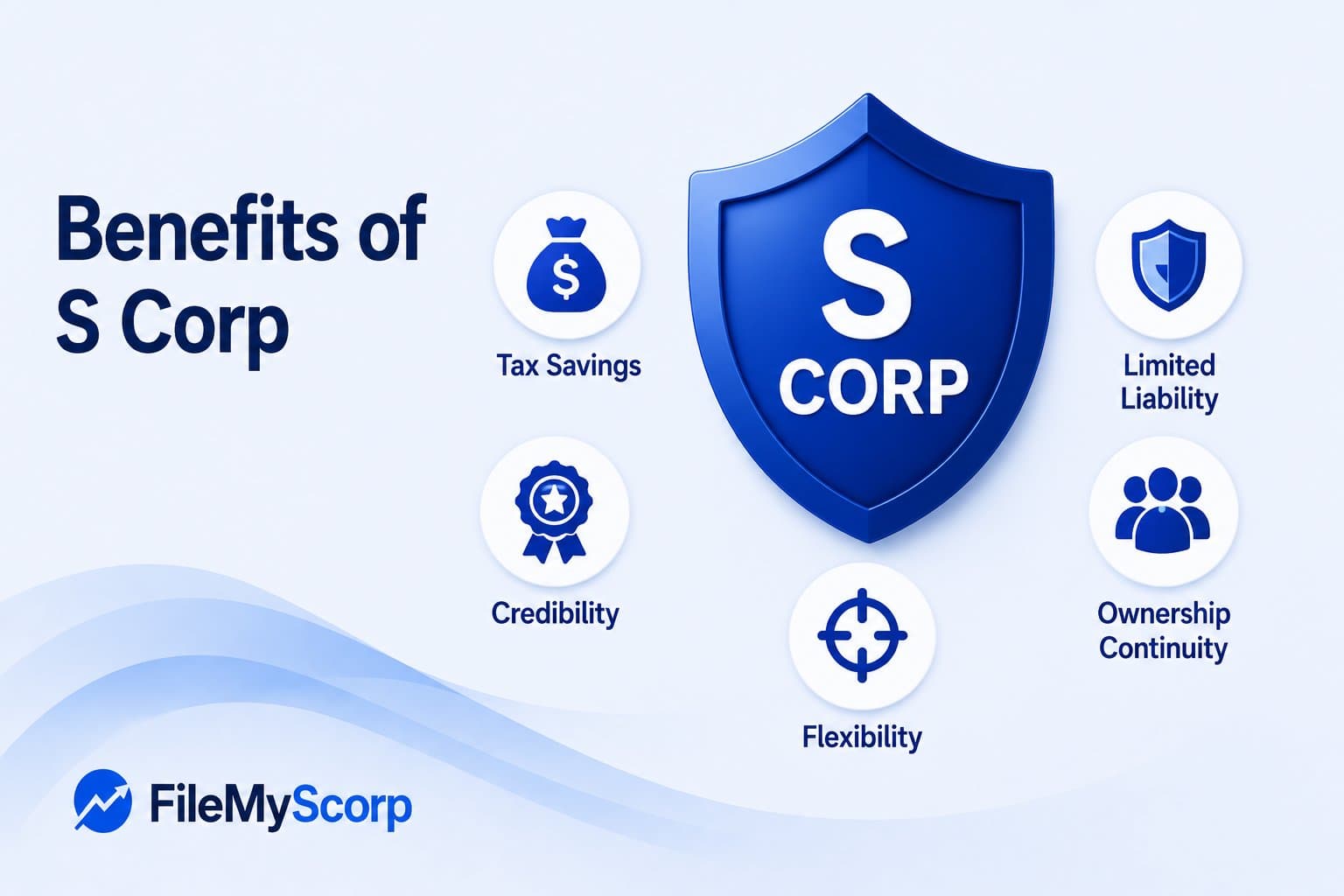
Before we dig deep, here's the punchline. The benefits of an S Corp election fall into five buckets:
- Self-employment / payroll tax savings — the headline benefit, and usually the biggest dollar item.
- Retirement plan supercharging — Solo 401(k) and SEP IRA contributions become much more powerful with an S Corp salary in the mix.
- Pass-through taxation without double tax — you get the corporate liability shield without the C Corp double-tax problem.
- Cleaner separation of compensation and ownership — wages, distributions, and equity become distinct, which helps with planning, partnerships, and exits.
- Credibility and structure — S Corps look like real businesses to lenders, vendors, and potential acquirers.
If you're netting $60,000+ per year in business profit, at least the first three are probably putting real dollars in your pocket. Let's unpack each.
Benefit #1: Self-Employment Tax Savings (the Big One)
This is the benefit everyone talks about, and for good reason. Here's how it works.
When you operate as a sole proprietor or a default LLC, the IRS treats every dollar of your business profit as self-employment income. You pay 15.3% in self-employment tax on the first ~$176,000 of net earnings (the Social Security wage base creeps up each year), then 2.9% Medicare (plus a 0.9% additional Medicare tax above $200K single / $250K joint) on every dollar above that.
That 15.3% is a tax most W-2 workers never feel. Their employer pays half (7.65%) and they pay the other half quietly out of every paycheck. When you're self-employed, you wear both hats, and the bill lands directly on your tax return.
When you elect S Corp status, you split your business income into two pots:
- Wages, which you pay yourself as a W-2 employee of your own company. These are subject to the full 15.3% payroll tax (split between "employer" and "employee" sides on paper, but you're paying both).
- Distributions, which you take as an owner. Distributions are not subject to self-employment tax or payroll tax.
The savings come from the gap between what you'd otherwise pay SE tax on (all of your profit) and what you actually pay payroll tax on (just your wages).
A Quick Example
Sara is a freelance UX designer netting $150,000 a year through her LLC. Without an S Corp election, she pays roughly $21,200 in self-employment tax — on top of regular income tax.
If Sara elects S Corp status and pays herself a defensible salary of $75,000, taking the remaining $75,000 as a distribution, she pays:
- Payroll tax on $75,000 wages: ~$11,475
- Payroll tax on $75,000 distribution: $0
That's roughly $9,700 in payroll tax savings every year. After backing out the extra cost of running the S Corp (payroll service, bookkeeping, S Corp tax return — call it $3,000–$4,000), she's still ahead $5,000–$7,000 per year. Over a decade, that's a small SUV's worth of money she would otherwise have handed to the IRS.
Two important caveats here:
- The salary you pay yourself has to be "reasonable" in the eyes of the IRS — you can't pay yourself $1 and call $149,999 a distribution. We'll come back to this.
- The savings shrink as your salary grows. The lever you're pulling on is the gap between salary and total profit. The wider, the better — within reason.
Benefit #2: Retirement Plan Supercharging
This is one of the most underrated benefits of an S Corp, and most owners don't fully realize how much it changes their retirement math until a CPA walks them through it.
Both a Solo 401(k) and a SEP IRA are great retirement vehicles for self-employed people. Both let you contribute as both "employee" and "employer" of your own business, which lets you sock away far more than a regular IRA. But the amounts you can contribute, and the type of contribution that's allowed, depend on what kind of "earnings" you have.
For a sole prop, contributions are based on net self-employment earnings.
For an S Corp, contributions are based on W-2 wages — the salary you pay yourself. Distributions don't count for retirement plan purposes (because they're not earned income for that test).
Why does that matter? Because:
- The Solo 401(k) lets you contribute up to $23,500 as an employee deferral (2025 limits, indexed for inflation each year), plus a separate employer contribution of up to 25% of your W-2 wages, with a combined cap of $70,000 (or $77,500 with catch-up if you're 50+).
- A SEP IRA lets you contribute up to 25% of your W-2 wages (no separate employee deferral), with the same overall cap.
Translation: when you set up your S Corp salary, you're not just optimizing for payroll tax savings — you're also setting the lever for how much you can shovel into retirement. Pay yourself too little salary and you protect SE tax but limit your retirement contributions. Pay yourself a comfortable salary and you can simultaneously max out a Solo 401(k) (employee deferral + 25% employer contribution) and still get meaningful payroll tax savings on your distribution.
Example
Suppose Marcus, our consultant from earlier, has an S Corp salary of $100,000. With a Solo 401(k):
- Employee deferral: up to $23,500
- Employer contribution: 25% × $100,000 = $25,000
- Total potential retirement contribution: $48,500
That's $48,500 of pre-tax (or Roth, if he prefers) retirement money for the year, on top of the SE tax savings he's already getting from the S Corp election. The deductible employer contribution also lowers the taxable income that flows through to him personally on his K-1.
For a sole prop with the same $100,000 of net earnings, the SEP/Solo math gets capped lower because of how self-employment income is calculated. The S Corp owner often ends up with several thousand dollars more they can legally tuck into retirement, every single year.
Stack 20 years of that on top of compound growth and you can see why "S Corp + Solo 401(k)" is the dominant playbook for high-earning solo professionals.
Benefit #3: Pass-Through Taxation Without the C Corp Double-Tax Trap
S Corps are pass-through entities. The corporation itself doesn't pay federal income tax. Instead, profits flow through to the owners' personal tax returns and are taxed there at individual rates.
That's a huge advantage over a traditional C Corporation, which gets taxed twice — once at the corporate level when the company makes money, and again at the personal level when the company distributes those profits as dividends. C Corp owners can lose 40%+ of their economic profit to that double-tax sandwich. S Corp owners avoid the corporate tax layer entirely.
This is the same pass-through benefit a default LLC enjoys. The S Corp election doesn't sacrifice it — it just adds a more advantageous tax wrapper around it.
The bonus on top of pass-through: S Corp owners may qualify for the Qualified Business Income (QBI) deduction under Section 199A — up to a 20% deduction on qualified business income. The deduction was made permanent under the One Big Beautiful Bill Act in mid-2025, with 2026 phase-out thresholds at roughly $203,000 (single) and $406,000 (joint).
For S Corp owners specifically, the QBI deduction applies to your business's profit after your reasonable salary is deducted. That creates an interesting planning lever: a higher salary saves no extra payroll tax (you already pay 15.3% on it) but reduces QBI. A lower salary preserves QBI but raises audit risk for unreasonable comp. For most owner-operators in or near the phase-out band, the right salary balances both — and that's exactly the conversation a good tax pro brings real value to.
Benefit #4: Liability Protection That Travels With the Business
This benefit is technically inherited from the underlying entity (the LLC or corporation), not from the S Corp election itself. But it's worth highlighting because many sole proprietors who finally make the move to a structured entity discover this benefit for the first time.
When you operate as a sole proprietor, you and the business are legally the same thing. If a customer trips on a client's job site and sues, your house, your savings, and your retirement are all fair game. There's no buffer.
Once you have an LLC or corporation in place — and you elect S Corp tax treatment on top — your personal assets are generally separated from the business's liabilities. A creditor or plaintiff can come after the business's assets, but not your personal stuff (unless they pierce the corporate veil, which usually requires you to have commingled funds or otherwise treated the business as your alter ego).
For most service business owners in 2026, this protection alone is worth the modest cost of forming an entity. Add in the tax savings of the S Corp on top and the value compounds.
A practical reminder: liability protection is conditional. Keep clean separation between business and personal finances, sign contracts in the business's name (not your personal name), maintain insurance, and follow the basic corporate housekeeping for your entity type. Otherwise, that protective shell can crack when you most need it.
Benefit #5: Credibility With Lenders, Vendors, Partners, and Buyers
This one is harder to quantify but real. A business operating as an S Corp shows up differently to the outside world than a sole prop with a side hustle.
- Lenders generally prefer to lend to entities with formal structures, audited or reviewed books, and clear separation between the owner's personal finances and the business. An S Corp, with its required payroll, separate tax return, and clean K-1 reporting, fits that mold.
- Enterprise customers often have vendor onboarding requirements that effectively rule out sole proprietors — they want a real EIN, formal corporate documents, certificates of insurance issued in the business's name, and so on.
- Partners and investors find an S Corp easier to onboard than a sole prop. Even if they ultimately need to convert it to a partnership or C Corp for the deal, starting from an S Corp is a cleaner cap-table conversation.
- Acquirers (think: a buyer for your business in 5–10 years) generally pay more, due diligence faster, and structure deals more cleanly when the target is a properly maintained S Corp with clean books, reasonable comp history, and a clear separation of owner compensation from owner equity.
In other words, the S Corp wrapper signals that you're running a real business, not a hobby. That signal compounds quietly over the life of the company.
Benefit #6: Cleaner Separation of Compensation From Ownership
For owners who plan to bring on partners, key employees with equity, or family members later, the S Corp structure creates a much cleaner mental and legal model than a default LLC.
In a default LLC, your "draws" to yourself are just money flowing out. In an S Corp, your money comes out as either salary (compensation for the work you do as an employee) or distributions (returns to you as an owner). Those two flows are tracked separately and reported separately.
That distinction matters when:
- You bring on a co-founder who works in the business but has different ownership %.
- You hire a key executive and want to grant them stock or stock options.
- You want to fairly reward a partner who's working harder than another partner without changing ownership %.
- You need to make capital contributions or take loans to/from the business and document them properly.
- You're preparing for an exit and need clean comp/equity records.
Default LLCs can do all of this too, but with much more flexibility (and therefore much more room for confusion). The S Corp's stricter structure forces the right discipline early.
Benefit #7: Self-Employment Health Insurance Deduction (Done Right)
S Corp owners who own more than 2% of the company can take the self-employed health insurance deduction for premiums on health, dental, and vision insurance — provided the premiums are paid by the corporation and reported on the owner's W-2 (in box 1 wages but not in boxes 3 or 5 for Social Security/Medicare).
Done right, this lets owners deduct what would otherwise be an after-tax personal expense. It's the same structure that's available to sole props, but the S Corp version is mechanically cleaner because it integrates with the W-2 payroll process.
Long-term care insurance premiums are also eligible (within IRS age-based limits), which becomes increasingly valuable for older owners.
Benefit #8: Built-In Discipline That Saves You From Yourself
This one isn't a tax benefit per se, but it's something every honest CPA will tell you: the S Corp election forces you to run your business like a real business. You can't just transfer money from the business account to your personal checking and call it a day. You have to:
- Run formal payroll (with all the discipline that creates).
- Keep books that distinguish wages from distributions from owner contributions.
- Track basis for each shareholder.
- File a real corporate tax return (Form 1120-S) and issue K-1s.
- Hold (or at least document) annual shareholder meetings if your underlying entity is a corporation.
The first time an S Corp owner has to do this stuff, it feels like a lot of extra work. By year two or three, it's the floor, not the ceiling — and the discipline pays off when you need a loan, when you bring on a partner, when you sell the business, or when (heaven forbid) the IRS comes knocking.
A surprising number of S Corp owners tell us the structural rigor was actually one of the biggest benefits, even if it wasn't what they signed up for.
When the Benefits Don't Apply (Important)
Let's be honest. The S Corp election isn't a magic bullet, and there are real situations where it doesn't make sense:
- Net business income under $40,000–$50,000. The compliance costs (payroll, bookkeeping, S Corp tax return, state fees) probably exceed the SE tax savings. Stay on default LLC treatment until your numbers grow.
- Volatile or unpredictable income. S Corps create rigid payroll obligations. If you have wild revenue swings or seasonal income, the inflexibility of running a "real" payroll all year long can hurt.
- Foreign owners or non-individual investors. S Corps require US-citizen-or-resident individual owners, certain trusts, or estates. Foreign or entity investors disqualify you.
- Multiple classes of ownership. S Corps must have a single class of economic ownership. If you want preferred returns, profit shifts, or liquidation preferences for some owners, an S Corp won't accommodate them.
- Real estate investors holding rental property. Holding rentals inside an S Corp is generally a tax disaster — you lose 1031 flexibility, depreciation strategy, and basis management. LLC partnership treatment is almost always better here.
- Business owners planning to retain large profits inside the business to fund growth (rather than distribute them). The S Corp structure is built around distribution; retained earnings inside an S Corp can create unique problems with AAA, basis, and shareholder taxation.
- High income above the QBI phase-out for SSTBs. Lawyers, accountants, doctors, financial advisors, and consultants above the income threshold lose QBI eligibility entirely, which changes the math.
A short list of "S Corp doesn't fit" cases, but not a small one. Always run your specific numbers — and your specific circumstances — through a tax pro before electing.
Side-by-Side: S Corp vs. Default LLC vs. C Corp Benefits
| Benefit | Sole Prop / Default LLC | S Corp | C Corp |
|---|---|---|---|
| Self-employment / payroll tax savings | None | Big (on distributions) | Different model — wages only |
| Pass-through tax (no entity-level tax) | Yes | Yes | No (double tax) |
| Liability shield | Only with LLC/corp | Yes | Yes |
| Retirement plan flexibility | Good | Better | Best (defined benefit easier) |
| QBI deduction eligible | Yes | Yes | No |
| Health insurance deduction for owner | Yes | Yes (with W-2 reporting) | Yes (employee benefit) |
| Restrictions on owners | None | US individuals only, ≤100, one class | None |
| Compliance complexity | Low | Moderate | High |
| Best for | Pre-profit, side hustle, low-margin | Profitable owner-operator US small business | Venture-backed, foreign owners, large retained earnings |
Three Real-World Owner Profiles Where the S Corp Shines
The freelancer whose income has finally stabilized. Joelle is a freelance copywriter who broke through $90K net for the first time last year. She's been a sole prop for years, paying full SE tax. With an S Corp election, a $50K salary, and a $40K distribution, she saves roughly $4,000–$5,000/year in payroll tax after compliance costs and starts a Solo 401(k) for the first time.
The agency owner approaching the exit. Devon owns a 5-person digital agency netting $400K. The S Corp gives him personal-asset protection, $20K+ in annual SE tax savings, a Solo 401(k) maxed each year, clean books for an eventual sale, and the structural discipline to onboard a key employee with phantom equity. The S Corp is the chassis for the whole next chapter of his business.
The professional with one foot in two worlds. Aliyah is a full-time dentist who also runs a profitable continuing-education business on the side. Her side business nets $130K. The S Corp election protects her dental income from SE tax leakage on the side gig, lets her deploy a separate retirement strategy, and creates a clean line between her clinical and educational business identities.
In all three cases, the S Corp isn't fancy. It's just well-fit to the owner's real situation.
Frequently Asked Questions
Is an S Corp better than an LLC?
It's the wrong question. An S Corp isn't an entity — it's a tax election. The right question is: should my LLC be taxed under default rules, or should I elect S Corp tax treatment? For profitable owner-operated businesses with US owners, the S Corp election usually wins on tax savings.
At what income should I start considering S Corp election?
Most owners see the math start working between $50K and $80K of net business income. Above $100K, it almost always pays off; above $150K, it's a clear win.
Will the S Corp election lower my income tax?
It mostly lowers your payroll/self-employment tax, not your income tax. Your overall income tax may shift slightly because of small differences in how the wages and distributions interact with deductions, but the headline savings are SE/payroll tax savings, not income tax savings.
Does an S Corp protect me from getting sued?
The protection comes from the underlying entity (your LLC or corporation), not from the S election. So an LLC with or without an S election offers the same liability shield — the S Corp is purely a tax decision.
Can an S Corp help me avoid taxes entirely?
No. Anyone telling you that is selling something. The S Corp shifts how your profit is taxed (less SE tax, same income tax) — it doesn't eliminate tax.
Do S Corps still get the QBI deduction?
Yes — both default LLCs and S Corps can qualify for the 20% Qualified Business Income deduction under Section 199A. The deduction was made permanent in 2025 with 2026 phase-out thresholds at ~$203K single / ~$406K joint.
Can I benefit from an S Corp election if I have a part-time business?
Probably not. The compliance costs of an S Corp (payroll, bookkeeping, separate tax return) generally exceed the savings unless your part-time business is netting at least $40K–$50K. Below that, default LLC treatment is usually the right answer.
Will I save on Medicare tax with an S Corp election?
Yes — the 2.9% Medicare component of payroll tax (and the 0.9% additional Medicare tax for high earners) doesn't apply to distributions, only to wages. For high-income S Corp owners, this Medicare savings is substantial because it doesn't have an upper cap like Social Security does.
Can I take an S Corp distribution if I haven't paid myself a salary?
In theory yes; in practice, never. Taking distributions without first paying yourself a reasonable W-2 salary is the #1 audit trigger for S Corps and an open invitation for the IRS to reclassify your distributions as wages with back payroll taxes and penalties. Always pay reasonable comp first.
What about state-level taxes? Are there S Corp benefits at the state level too?
It varies. Most states honor the federal S Corp election and provide pass-through treatment at the state level too. A few states (NJ, for example) require a separate state-level S election. A few states (CA, NY, TX) have entity-level taxes or surcharges that erode some of the federal benefit. Check your state's rules.
How do I actually elect S Corp status?
You file IRS Form 2553 — a short two-page form — within 75 days of your tax year start (for calendar-year businesses, that's typically March 15). For new entities, you have 75 days from formation. We've written a step-by-step Form 2553 guide that walks through every line.
The Bottom Line
The benefits of an S Corp election are real, but they're not universal. For the right owner — profitable, US-based, with a stable business and a willingness to run real payroll — the S Corp is one of the highest-ROI tax strategies in the entire small-business toolkit. The payroll tax savings, retirement supercharging, QBI eligibility, liability shield (via the underlying entity), and structural credibility add up to thousands of dollars per year and a meaningfully better-run business.
For the wrong owner — too small, too volatile, with the wrong kind of investors, or in real estate — the same election can be a costly distraction.
The trick is knowing which side of that line you're on. That's not a one-size-fits-all answer; it's a numbers question that should be modeled with your specific income, state, and goals.
File Your S Corp Election With FileMyScorp
Once the math says yes, the actual filing is one form — IRS Form 2553. But it's paper-only (no e-file, no IRS online portal), has to be faxed or mailed to the right service center, and one missing signature voids the whole thing. FileMyScorp is the cheapest guided 2553 platform on the market, built for owners who want to file it themselves without becoming IRS-routing experts.
- The cheapest pricing in the market. $49 fax · $50 certified mail · $99 for both (same-day). Flat one-time fee, no subscription, no upsells.
- Fax AND certified mail in one place. Most filers do one or the other. We dispatch both same-day, auto-route to the correct IRS service center for your state (Kansas City vs. Ogden), and track delivery on your dashboard.
- DIY-first, no consultation upsell. Owner does the ~10-minute intake. Shareholders e-sign on their phones. We prepare, sign, send.
- Late elections free. Rev. Proc. 2013-30 narrative auto-assembled from a 4-question form — no extra tier, no surcharge.
- Live status from intake → CP261. Every milestone (signed, faxed, delivered, certified-mail tracking, IRS acceptance letter received) hits your inbox and your dashboard.
Start your filing → — most filings go from intake to fax confirmation in under an hour.
This article is general educational information, not tax, legal, or financial advice for your specific situation. Tax law changes, your facts matter, and what's right for one business may be wrong for another. Always confirm with a qualified CPA, EA, or attorney before making any tax or structural decision for your business.
Related articles
- September 9, 2026 · 8 minThe Form 2553 Deadline for 2026 (and What to Do Now)The Form 2553 deadline for 2026 was March 16. Here's what still works in September: the 2-month-15-day rule for new entities, late relief, and electing for 2027.
- August 26, 2026 · 9 minWhy S Corp elections eat your billable hours (and what tax pros can actually control)A successful fax confirmation is not proof your S election was processed. What practitioners are actually seeing with Form 2553 — vanished elections, entity-mismatch rejections, and the workarounds that get returns filed.
- August 5, 2026 · 4 minNew Jersey S Corp Election: Why You (Probably) Don't Need to File AnythingSince December 22, 2022, New Jersey automatically honors your federal S Corp election — no Form CBT-2553, no separate state filing. Here's how the rule works, the two exceptions, and how NJ compares to New York.